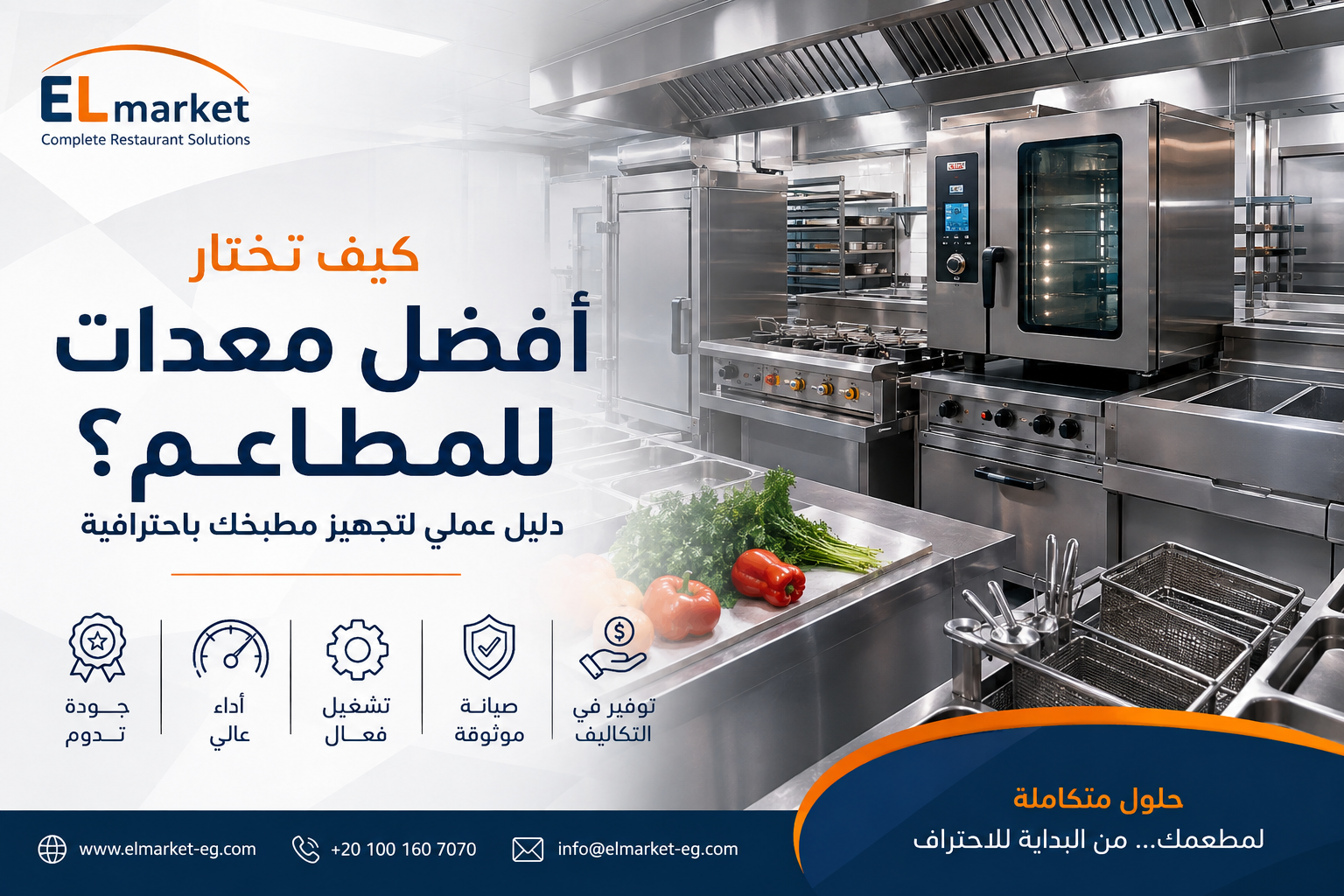
Build Your Kitchen with the Right Equipment
How to Choose the Best Restaurant Equipment: A Practical Guide to Professional Kitchen Setup
Choosing the right restaurant equipment is not simply about comparing prices or selecting the equipment with the best appearance. The equipment inside your kitchen has a direct impact on operational efficiency, food quality, energy consumption, maintenance costs, and the overall speed of service.
Whether you are opening a new restaurant, upgrading an existing kitchen, or planning equipment for a restaurant chain, choosing the right commercial kitchen equipment should always start with your actual operational requirements—not just the purchase price.
In this guide, we explain the most important factors to consider when choosing the best restaurant equipment and getting the best value from your investment.
Why Is Choosing the Right Restaurant Equipment Important?
A commercial kitchen operates for long hours and under constant pressure. Therefore, the equipment you choose must be designed to handle professional foodservice operations.
Choosing unsuitable equipment can lead to:
-
Slower food production.
-
Longer order preparation times.
-
Higher electricity or gas consumption.
-
Increased maintenance costs.
-
Operational downtime caused by equipment failures.
-
Difficult cleaning and sanitation.
-
Inconsistent product quality.
On the other hand, choosing the right equipment helps create a more efficient and organized kitchen, allowing your team to work faster and maintain consistent operating standards.
1. Start with Your Restaurant's Needs—not the Equipment Price
One of the most common mistakes restaurant owners make is purchasing equipment before defining their actual operational requirements.
Before choosing any equipment, ask yourself:
What is my expected production volume?
Will your restaurant serve 50 meals per day or 500?
Does your business focus on:
-
Fast food?
-
Fried chicken?
-
Burgers?
-
Pizza?
-
Bakery products?
-
Coffee and beverages?
-
Catering?
-
Multiple food categories?
Every type of restaurant requires a different equipment setup.
Equipment that works perfectly for a small restaurant may not be suitable for a high-volume restaurant chain, and vice versa.
2. Calculate the Required Production Capacity
Do not choose equipment based only on its size or appearance.
The most important factor is its capacity and production output.
For example, if your restaurant needs to produce a high volume of food during peak hours, purchasing equipment with limited capacity can create bottlenecks in your kitchen workflow.
When comparing restaurant equipment, consider:
-
Production capacity.
-
Operating speed.
-
Equipment size.
-
Daily operating hours.
-
Peak-hour order volume.
-
Ability to handle continuous commercial use.
Choosing equipment based on your expected production volume is one of the most important principles of professional kitchen design.
3. Quality Matters More Than Price Alone
Is the cheapest equipment always the best choice?
Not necessarily.
There is a major difference between the purchase price and the total cost of ownership.
An inexpensive piece of equipment may cost less initially but could consume more energy, require frequent repairs, or have a shorter operational lifespan.
Instead of asking only:
How much does this equipment cost?
Ask:
How much will this equipment cost me throughout its operating life?
Consider:
Purchase price + energy consumption + maintenance + spare parts + expected lifespan + downtime costs.
The best investment is not always the equipment with the lowest purchase price. It is the equipment that delivers the best long-term value.
4. Choose Materials Suitable for Commercial Use
In professional kitchens, equipment construction materials are an essential consideration.
Stainless steel is widely used in commercial kitchen equipment because of its suitability for professional environments, ease of cleaning, and corrosion resistance when the appropriate grade and specifications are selected.
However, simply choosing "stainless steel" is not enough.
You should also consider:
-
Stainless steel grade.
-
Material thickness.
-
Welding quality.
-
Surface finishing.
-
Structural strength.
-
Ease of cleaning.
-
Foodservice suitability.
Most importantly, the equipment should be designed for commercial foodservice use, rather than light residential use.
5. Consider Energy Efficiency
Equipment that operates for many hours every day can have a significant impact on your operating costs.
When choosing:
-
Fryers.
-
Ovens.
-
Grills.
-
Refrigerators.
-
Freezers.
-
Dishwashers.
-
Cooking equipment.
Energy efficiency should be part of your comparison criteria.
High-efficiency commercial foodservice equipment can help restaurants reduce energy, water, and maintenance costs while maintaining the required performance.
The best equipment is not necessarily the equipment with the lowest purchase price. It is the equipment that provides the best overall operating efficiency.
6. Easy Cleaning Is Part of Equipment Quality
Commercial kitchens require frequent cleaning and sanitation.
Before purchasing any equipment, ask:
Is it easy to clean?
The easier the equipment is to clean, the easier it becomes to maintain proper hygiene and daily operating standards.
Look for designs that:
-
Reduce food residue buildup.
-
Provide easy access to areas that require cleaning.
-
Minimize hard-to-reach corners.
-
Allow regular cleaning without complicated disassembly.
-
Support proper food safety and sanitation practices.
Good equipment design should make cleaning easier—not create additional work for your kitchen team.
7. Don't Overlook Small Restaurant Equipment and Operating Tools
When people talk about restaurant equipment, they often focus only on major equipment such as fryers, ovens, refrigerators, and freezers.
However, smaller operating tools can have a major impact on daily workflow.
Examples include:
-
Fryer baskets.
-
Potato handling tools.
-
Professional knives.
-
Seasoning tools.
-
Food trays.
-
Cleaning tools.
-
Food thermometers.
-
Dough proofing equipment.
-
Food preparation tools.
These items may appear small, but they are used repeatedly throughout the day and can directly affect speed, consistency, and operational efficiency.
8. Oil Filtration Is an Important Part of Frying Operations
If your restaurant relies heavily on fried food, you should not look at the fryer alone.
An effective cooking oil filtration system can be an important part of your overall frying operation.
Food particles and residues generated during frying can affect oil condition and the quality of the final product. Proper filtration can help remove unwanted particles and support better oil management.
ELmarket specializes in cooking oil filtration systems and filter paper, in addition to restaurant equipment and commercial kitchen operating supplies.
When choosing an oil filtration solution, consider:
-
Fryer capacity.
-
Number of fryers.
-
Daily production volume.
-
Type of cooking oil.
-
Frequency of frying.
-
Manual or automatic filtration.
-
Cleaning and maintenance requirements.
Choosing the right filtration solution should be based on your actual kitchen operation—not simply the size of the fryer.
9. Consider Maintenance and Spare Parts Before Buying
What happens if your equipment breaks down?
This question should be part of your purchasing decision.
Before buying restaurant equipment, ask your supplier about:
-
Spare parts availability.
-
Warranty.
-
Maintenance services.
-
Technical support.
-
Response time.
-
Availability of operating supplies.
-
After-sales service.
Having a reliable supplier and technical support partner can be extremely important, especially for restaurants that depend on continuous daily operation.
A good supplier should not disappear after the sale. Your relationship with the supplier should continue throughout the equipment's operating life.
10. Choose a Supplier Who Understands the Restaurant Industry
Purchasing restaurant equipment is not simply a buying-and-selling transaction.
A professional supplier should help you answer important questions such as:
What equipment is suitable for my restaurant size?
What production capacity do I need?
Which equipment do I actually need?
Which purchases can be postponed?
How can I achieve better operational efficiency within my budget?
This is why working with a company that understands restaurants, foodservice operations, and commercial kitchens can make a significant difference.
How to Choose Restaurant Equipment Based on Business Size
Small Restaurants
Focus on essential, versatile equipment and avoid purchasing equipment that is significantly larger than your actual production needs.
Prioritize:
-
Reliability.
-
Ease of use.
-
Easy cleaning.
-
Energy efficiency.
-
Reasonable investment.
-
Availability of maintenance and spare parts.
Medium-Sized Restaurants
At this stage, you should focus more heavily on:
-
Production capacity.
-
Operating speed.
-
Kitchen workflow.
-
Reducing order preparation time.
-
Oil filtration.
-
Storage.
-
Food preparation equipment.
The goal is to create a kitchen capable of handling higher demand without unnecessary operational complexity.
Restaurant Chains and Central Kitchens
The requirements become more advanced for restaurant chains and central production kitchens.
Key considerations include:
-
Standardizing equipment across branches.
-
Easy maintenance.
-
Spare parts availability.
-
High production capacity.
-
Automation.
-
Quality control.
-
Operating cost reduction.
-
Easy staff training.
-
Reliable supply.
Standardizing equipment across multiple locations can also make staff training, maintenance, and operational procedures easier to manage.
Common Mistakes to Avoid When Buying Restaurant Equipment
1. Choosing Equipment Based Only on Price
The lowest price does not always mean the best value.
2. Buying Equipment That Is Too Large
Oversized equipment can increase your investment and operating costs without providing meaningful benefits.
3. Ignoring Energy Consumption
Daily operating costs can eventually become much more significant than the initial difference in purchase price.
4. Forgetting About Maintenance
Even high-quality equipment can become a problem if spare parts and technical support are not available.
5. Choosing Equipment That Does Not Match Your Business
Equipment designed for a burger restaurant may not be the ideal choice for a pizza restaurant, bakery, or central kitchen.
6. Ignoring Your Kitchen Layout
Equipment dimensions should work with your available space, workflow, storage areas, and staff movement.
What Is the Best Restaurant Equipment?
The best restaurant equipment is not necessarily the most expensive or the cheapest.
The right equipment is the one that provides the best balance between:
Quality + Performance + Production Capacity + Energy Efficiency + Easy Cleaning + Maintenance + Operating Life + Technical Support.
That is why restaurant equipment selection should begin with a clear understanding of your operation, production volume, kitchen layout, and budget.
At ELmarket, we provide integrated solutions and operating supplies for restaurants, hotels, and commercial kitchens—from restaurant equipment and kitchen supplies to cooking oil filtration systems and filter paper.
Our goal is to help foodservice businesses choose practical solutions that support efficient operations, consistent quality, and long-term value.
Build Your Kitchen with the Right Equipment
Whether you are opening a new restaurant, upgrading an existing kitchen, or expanding into multiple locations, the right equipment can make a real difference in your daily operation.
Don't choose equipment simply because it looks good or has a lower price.
Choose based on your operation. Choose based on performance. Choose based on long-term value.
Explore restaurant equipment, commercial kitchen supplies, oil filtration solutions, and professional foodservice products with ELmarket.
ELmarket | Quality Starts Here
Restaurant Equipment • Commercial Kitchen Supplies • Oil Filtration Systems • Filter Paper • Foodservice Solutions